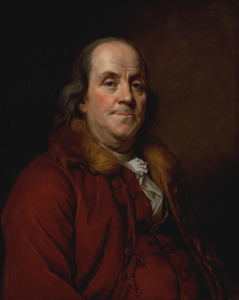
January is a fitting month to remember Benjamin Franklin, a man whose life reflected the values of discipline, curiosity, public service, and practical wisdom. Born on January 17, 1706, Franklin became one of the most recognizable figures in American history, yet his legacy is larger than invention or diplomacy alone. He was a printer, author, philosopher, civic organizer, scientist, diplomat, and a Brother whose Masonic life helped shape the early public image of the Craft.
Franklin’s genius was not simply that he knew many things, but that he used what he knew for the common good. In an age when information traveled slowly and institutions were still being formed, he understood the power of the printed word. As a printer and publisher, he helped spread ideas that educated the public and encouraged self-improvement. His famous emphasis on virtue, industry, and prudence still resonates because it was never merely theoretical. He tried to live what he taught.
His contribution to the world is easy to measure in historic terms. Franklin helped establish libraries, civic societies, fire brigades, and systems of mutual improvement that strengthened communities from the ground up. He was also a key figure in America’s founding era, serving as a diplomat in France and helping advance the cause of independence. Yet what makes Franklin especially useful to a Masonic lodge is that his influence was never only political or intellectual. He was practical. He believed in order, education, fraternity, and progress through deliberate effort.
In Masonic history, Franklin is remembered as one of the most important early American Brothers. His association with Freemasonry connected him to a tradition of moral formation, brotherly fellowship, and public virtue. He embodied the idea that a man should be useful in the world and honorable in the lodge. Franklin did not treat learning as a vanity; he treated it as a responsibility. That is a deeply Masonic idea. Knowledge, when properly ordered, should build character and bless others.
For the modern Mason, Franklin’s life offers several lessons. First, a Brother should be committed to growth. Franklin never stopped improving himself, and he never separated knowledge from action. Second, a Brother should be useful to his community. Franklin’s life reminds us that the true test of wisdom is whether it serves others. Third, a Brother should understand that reputation is built by consistency over time, not by grand declarations alone.
His example also reminds us that the Craft should produce men who are thoughtful, disciplined, and ready to contribute to the common good. Franklin’s work in science, publishing, diplomacy, and civic life all showed a man who believed that light must be shared. He did not hoard insight; he circulated it. He did not merely admire virtue; he practiced it as a daily discipline. That spirit belongs in every lodge.
As you begin this new year, consider Benjamin Franklin not as a distant historic figure, but as a model of what a man can become when intelligence is guided by principle and effort is governed by purpose. A Mason should strive to be known not only for what he knows, but for what he builds, what he strengthens, and what he leaves better than he found it.
Brother, let Franklin’s example move you to greater industry, steadier virtue, and more faithful service. Be a man whose light is useful, whose labor is honest, and whose life leaves your brethren and community stronger than before.