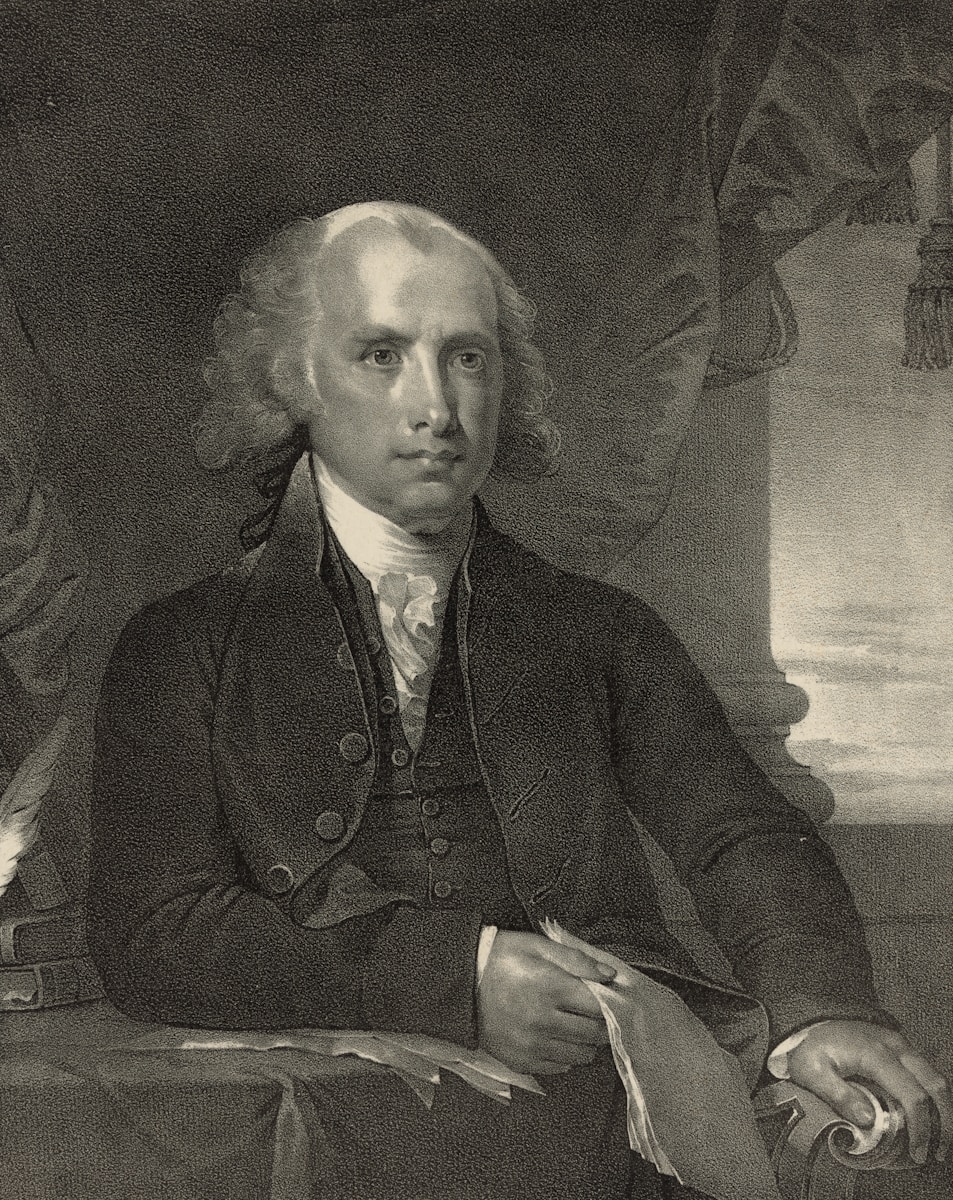
March is an excellent month to reflect on James Madison, a statesman whose quiet brilliance helped shape the constitutional foundations of the United States. Born on March 16, 1751, Madison is often remembered as the “Father of the Constitution,” and for good reason. He was one of the most important architects of American government, yet his style was marked less by spectacle than by careful thought, disciplined study, and a deep concern for the stability of the republic.
Madison’s greatest contribution to the world was his role in creating and defending the Constitution of the United States. He understood that free government required more than noble language. It required structure, balance, and accountability. His work in the Federal Convention and his writing in the Federalist Papers helped lay the intellectual foundation for a durable republic. Later, as president during the War of 1812, he faced the difficult reality of governing in a time of national pressure and uncertainty. Through it all, Madison remained committed to reasoned governance and constitutional order.
From a Masonic perspective, Madison is significant because his life reflects the same careful, constructive spirit that governs good work in the lodge. Freemasonry teaches men to build with purpose, to measure before they cut, and to proceed with patience and discipline. Madison’s statesmanship followed that pattern. He did not merely react to problems; he studied them and sought solutions that could endure. That is a distinctly Masonic way of thinking: not impulsive, but deliberate; not reckless, but foundational.
Although Madison’s public reputation is often more reserved than that of Washington or Franklin, his influence is immense. Men who build wisely are sometimes less celebrated than men who appear more dramatic, yet their work can be even more important. Madison reminds us that the quiet builder is no less worthy of honor than the visible hero. In both civic life and Masonic life, stability often depends on men who labor carefully in the background.
For the Brother reading this, Madison’s life offers an important challenge. The world often rewards speed, noise, and visibility, but lasting institutions are formed by men who value truth, patience, and order. A Mason should not be content to simply react to the age. He should seek to shape it with wisdom. Madison’s example shows that the good of the whole often depends on a small number of men who are willing to think deeply and act responsibly.
Madison also teaches the importance of protecting liberty with moral seriousness. He knew that freedom can be weakened not only by external threats, but by internal disorder. That principle speaks to every lodge member who wants to be a steady man in an uncertain world. A Mason should be a builder of peace, clarity, and good governance in his home, his church, his workplace, and his community.
As you remember James Madison this March, reflect on the value of careful work, thoughtful leadership, and long-term vision. Great things are not always loud. Often they are built quietly, with precision and faithfulness, by men who understand their duty.
Brother, be steady in your judgment, patient in your labor, and faithful in your responsibility. Build well, think deeply, and let your life reflect the wisdom of a man who knows that good foundations support every worthy structure above them.